
Industrial ovens https://8ruiyan.com/en/all-preheat-furnaces/and thermal oil heaters are key partners in factory heating. They work together for processes like drying, baking, and curing. This guide explains what they are and how they work.
What is an Industrial Oven?
Industrial ovens are heated chamber. It is used to process materials.
- Main Job: Its job is to provide controlled heat. This heat dries products. It bakes coatings. It also cures materials.
- Common Type: A common type is the forced-air convection oven. It uses a fan. The fan circulates hot air. This gives very even temperature.
- Typical Use: You find these ovens in many industries. They are used for food processing, chemical work, and making electronics.
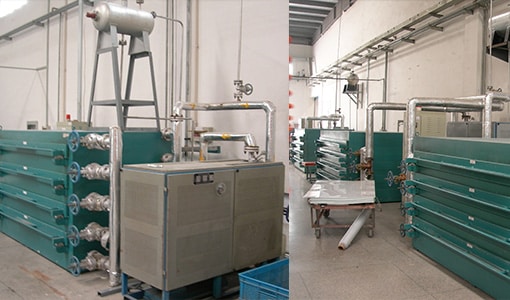
How Does a Thermal Oil Heater Work with an Oven?
A thermal oil heater is a separate heating unit. It is also called a hot oil boiler. It does not heat the oven directly.
Here is how the system works:
- Heats the Oil: First, it heats a special fluid (thermal oil). The oil gets very hot, often above 300°C.
- Pumps the Oil: Then, a pump moves the hot oil. The oil travels through pipes. These pipes are inside the oven’s walls or shelves.
- Transfers Heat: The hot pipes warm the air inside the oven chamber.
- Returns the Oil: The cooler oil flows back to the heater. The cycle starts again.
Why use this system? It has big benefits:
- Safer: The heat source is outside the oven.
- More Uniform Heat: The oil provides steady, even temperature.
- More Efficient: It is great for high temperatures or heating multiple ovens.
How to Calculate the Required Power?
Choosing the right power is very important. Too little power won’t heat the oven. Too much power wastes energy and money.
You need to calculate the total heat needed. Think about three things:
- Heat for the Product (Q₁): Energy to warm your materials.
- Heat for the Oven (Q₂): Energy to warm the oven structure itself (only at startup).
- Heat Loss (Q₃): Energy lost through the oven walls and door during operation.
A basic formula for steady power (mainly for Q₁ + Q₃) is:
P (kW) = [m × c × ΔT] / (860 × t)
- P = Power in kilowatts (kW)
- m = Mass of your material (kg)
- c = Specific heat of your material (kcal/kg°C)
(Example: Steel is ~0.11, Water is 1.0) - ΔT = Temperature rise needed (°C)
- t = Time to reach the temperature (hours)
A Simple Example:
You need to heat 100kg of steel from 20°C to 200°C in 1 hour.
- P = (100 kg × 0.11 kcal/kg°C × 180°C) / (860 × 1 hr)
- P ≈ 2.3 kW
Important Note: This 2.3 kW is just for the steel. You must add extra power for the oven’s heat loss (Q₃). Heat loss is often the biggest part. For a good estimate, talk to an equipment supplier. They can help with the final calculation.
A Quick Estimation Method
For a rough idea, a well-insulated oven often needs about 2 to 4 kW of power for every cubic meter of its chamber space.
Conclusion
Industrial ovenS do the processing work. A thermal oil heater provides the heat efficiently. To size your system, start with the power calculation. Use the simple formula as a guide. For the best result, always consult with a specialist for your final design.
For further consultation, please contact our technical team for expert advice.
Whatsapp:86-19106101570
wechat:86-19106101570
email:fob@jsryan.com
 Chinese
  Russian
  Indonesian
  German
  French
  Italian
  Spanish
  Portuguese
  Polish
  Czech
Czech  Turkish
  Korean
  Japanese
  Arabic
  Persian
  Dutch
Dutch  English