For over a hundred years, the plastics and fiber industries have relied on polymer cleaning to remove residues from processing equipment. This journey—from crude manual scraping to today’s advanced vacuum pyrolysis—reflects not only technological progress but also a growing understanding of materials, safety, and environmental responsibility.
The Early Days: Brute Force and Open Burning
In the early 20th century, cleaning meant mechanical scraping or open-flame burning. Operators would place clogged spinnerets, dies, and screws over gas torches or in simple ovens. The goal was simple: carbonize the polymer until it turned to ash.
This method worked, but at a cost. High temperatures often softened or warped metal components. The process produced thick black smoke and toxic fumes. Workers faced constant exposure to harmful gases. It was effective in a crude sense, but unsafe and unpredictable.
The Chemical Era: Solvents and Salt Baths
By the 1950s and 1960s, chemical cleaning gained popularity. Hot solvents like trichloroethylene and methylene chloride dissolved polymer residues. For tougher deposits, molten salt baths (sodium hydroxide based) offered an alternative.
These methods were more controlled than burning. However, they introduced new problems. Chemical waste required expensive disposal. Salt baths operated at high temperatures and posed severe burn hazards. Some solvents damaged sensitive parts like filter elements and precision spinneret holes.
The Fluidized Bed and Controlled Oxidation
The 1970s brought fluidized bed technology. Heated sand or alumina particles, fluidized by air, created a uniform temperature zone. Polymer deposits decomposed through controlled oxidation at around 400–450°C.
This improved temperature uniformity and reduced metal fatigue. Yet it was energy intensive. The process also required careful exhaust treatment, as combustion byproducts remained an environmental concern.
The Vacuum Pyrolysis Breakthrough
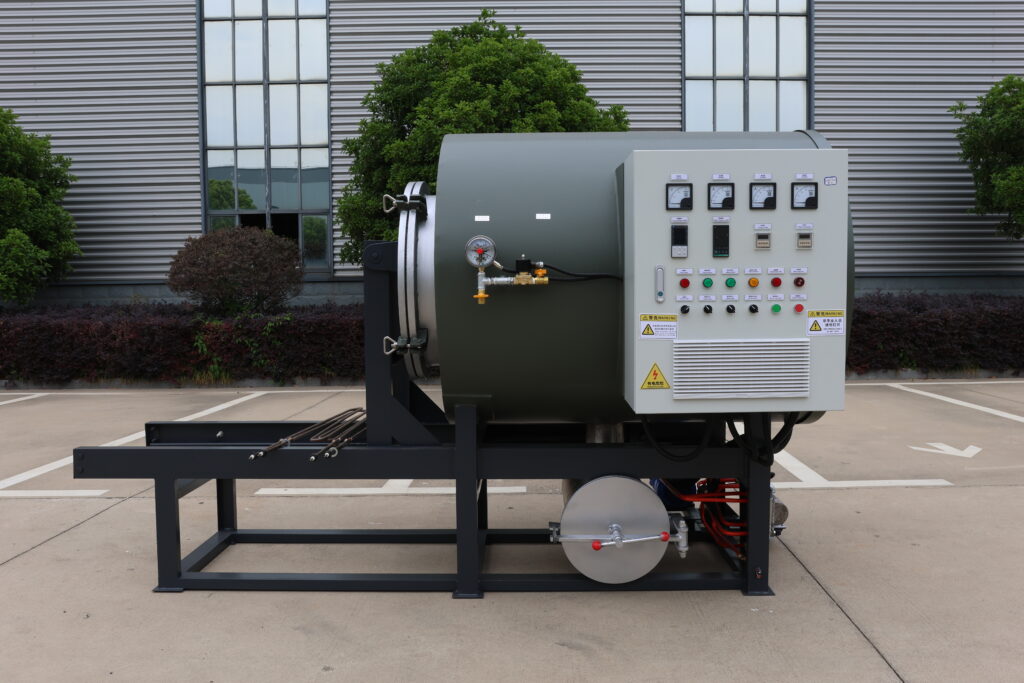
The real shift came with vacuum pyrolysishttps://8ruiyan.com/en/all-vacuum-cleaning-furnaces/. Instead of relying on combustion, vacuum furnaces apply heat under reduced pressure. In this environment, polymer chains break down into volatile oligomers and gases. A separate afterburner or catalytic oxidizer then treats these emissions.
This approach brought three fundamental improvements:
1. Material Safety. Vacuum eliminates the oxygen needed for open burning. Without oxidation, metal parts experience less scaling and corrosion. Precision tools like spinnerets and filters maintain their original tolerances much longer.
2. Cleaner Output. The pyrolysis process is inherently cleaner. Off-gases are fully oxidized in a post-treatment chamber, leaving no visible smoke or hazardous residues. This aligns with modern emission standards and workplace safety regulations.
3. Process Control. Modern vacuum cleaning systems use programmable temperature ramps. Operators can tailor heating profiles to specific polymers—whether polyamide, polyester, polyethylene, or polypropylene. Each polymer has an optimal decomposition window, and vacuum systems can follow it precisely.
Why the Evolution Matters Today
Today’s vacuum pyrolysis systems represent the cumulative knowledge of decades. They combine:
- Advanced vacuum sealing and pumping
- Multi-zone temperature control
- Automated cycle programming
- Integrated emission treatment
- Cool-down and unloading without operator exposure
The contrast with early open burning could not be starker. What once required hours of manual scraping and toxic smoke is now a closed-loop, automated process.
Looking Forward
The evolution of polymer cleaning is not finished. Future systems may integrate AI-based cycle optimization, real-time residue monitoring, and energy recovery from pyrolysis gases. Cleaner, safer, and more efficient—this trajectory continues.
From fire and scrapers to vacuum and software, the story of polymer cleaning is one of respect: respect for equipment, for the environment, and for the people doing the work.
For further problems about polymer cleaning, please contact our technical team for expert advice.
Whatsapp:86-19106101570
wechat:86-19106101570
email:fob@jsryan.com
 Chinese
  Russian
  Indonesian
  German
  French
  Italian
  Spanish
  Portuguese
  Polish
  Czech
Czech  Turkish
  Korean
  Japanese
  Arabic
  Persian
  Dutch
Dutch  English