
In industrial automation, two terms often appear together: PID Control vs. PLC Control. They are not interchangeable. In fact, they serve completely different purposes.https://8ruiyan.com/en/all-organic-heat-carrier-boilers/
This post explains the difference simply and clearly.
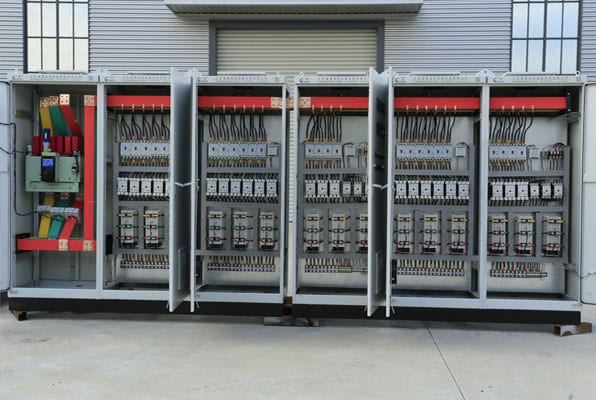
What Is a PLC?
A PLC stands for Programmable Logic Controller. It is a rugged industrial computer. It reads inputs from sensors. It executes a user-written program. It then drives outputs to actuators.
A PLC handles many tasks. It manages start/stop sequences. It controls timers and counters. It communicates with other devices. It also performs safety functions.
What Is PID Control?
PID stands for Proportional-Integral-Derivative. It is a control algorithm. It calculates a correction value. This value adjusts a process variable.
The goal is to match a setpoint. Think of temperature control. The PLC reads the temperature. The PID algorithm calculates the required heater power. It then sends that signal to the heater.
PID is a math function. It is not hardware. It is a method.
The Core Difference
PLC is a platform. PID is a tool.
The PLC is the hardware and operating system. The PID algorithm runs inside the PLC. It is one of many functions the PLC can perform.
Think of a smartphone. The phone is the platform. The camera app is a tool. You use the app for a specific task. Similarly, the PLC runs the PID loop for a specific control task.
When Do You Use Each?
You use a PLC for overall machine control. It handles logic, sequencing, and communication.
You use PID for continuous process control. It is best for variables like:
- Temperature
- Pressure
- Flow rate
- Level
In many systems, the PLC executes the PID loop. The PLC reads the sensor. It runs the PID calculation. It sends the output to the final control element.
Dedicated PID Controllers
Sometimes, engineers use a separate PID controller. This is a standalone device. It has its own processor. It is dedicated only to PID control.
This approach is useful for critical loops. It reduces the load on the PLC. It also offers faster response times.
However, modern PLCs are powerful. They can handle multiple PID loops easily. Most new systems integrate PID into the PLC.
Tuning Differences
PID tuning is a skill. You adjust three parameters: Proportional, Integral, and Derivative. Each affects system response.
PLC programming is different. You write ladder logic or structured text. This defines the sequence of operations.
Tuning is about dynamics. Programming is about logic.
Summary
| Aspect | PLC | PID |
|---|---|---|
| What it is | Hardware + software platform | Control algorithm |
| Main role | Sequence and logic control | Continuous process regulation |
| Flexibility | High – many functions | Single function |
| Implementation | Programmed by engineer | Tuned by engineer |
Final Thought
Do not confuse the two. A PLC is the brain of the machine. PID is one of its thinking methods.
You cannot choose between them. You choose how to implement PID. You can use a built-in PLC block, a dedicated controller, or a software library.
The best choice depends on your application. For simple logic, a PLC alone is enough. For tight process control, add a well-tuned PID loop.
That is the practical difference. Keep it simple. Choose the right tool for the job.
For further problems about PID Control vs. PLC Control, please contact our technical team for expert advice.
Whatsapp:86-19106101570
wechat:86-19106101570
email:fob@jsryan.com
 Chinese
  Russian
  Indonesian
  German
  French
  Italian
  Spanish
  Portuguese
  Polish
  Czech
Czech  Turkish
  Korean
  Japanese
  Arabic
  Persian
  Dutch
Dutch  English