
An organic heat transfer fluid system https://8ruiyan.com/en/all-organic-heat-carrier-boilers/ should reach and hold temperature predictably. When it doesn’t, it’s a clear sign something is wrong. Abnormally slow or fast heating points to inefficiency, safety risks, or component failure. Understanding the causes is the first step to a solution.
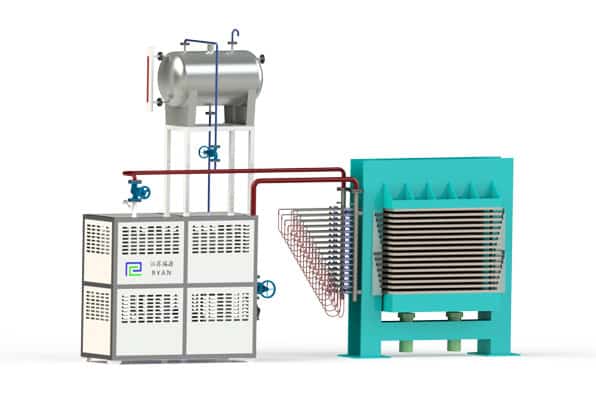
Part 1: Symptoms of Abnormal Heating
- Slow Heating: The system takes much longer than usual to reach the setpoint. Fuel or electricity consumption is high, but temperature rises slowly.
- Fast/Uncontrolled Heating: Temperature spikes rapidly or overshoots the setpoint. This can be more dangerous than slow heating.
- Inability to Reach Temperature: The system plateaus below the desired operating temperature, no matter how long it runs.
Part 2: Common Causes of Slow Heating
- Fluid Degradation: Old, oxidized, or cracked oil has poor heat transfer properties. It loses its ability to carry heat efficiently.
- Pump Issues: A failing circulation pump provides insufficient flow. Low flow means less heat is carried away from the heater. Check for cavitation noise or low pressure.
- Air in the System (Aeration): Air bubbles in the fluid act as an insulator. They reduce the fluid’s heat capacity and can cause pump cavitation.
- Clogged Filters or Strainers: Restricted flow severely limits the entire system’s heat transfer capability.
- Fouled Heat Exchanger Surfaces: Scale or coke buildup on heater tubes or process coils creates a thermal barrier. Heat cannot transfer into the fluid effectively.
- Undersized Heater: The heater’s power output (kW) may simply be too low for the required heat load, especially after a process change.
Part 3: Common Causes of Fast/Uncontrolled Heating
- Control System Failure: A faulty temperature sensor (thermocouple/RTD) sends incorrect readings. A stuck control valve or failed PID controller can’t regulate power.
- Low Fluid Level: A critically low fluid level reduces the system’s thermal mass. The remaining fluid overheats very quickly.
- Bypass Valve Malfunction: A valve that should direct fluid through the heater is stuck or incorrectly set, causing improper flow paths.
Part 4: Step-by-Step Diagnostic & Action Plan
Step 1: Initial Safety & Observation
- Note the exact symptoms. Check control panel readings for temperature, pressure, and pump status.
- For sudden fast heating: Consider an emergency shutdown if safe to do so, to prevent thermal shock or over-temperature.
Step 2: Investigate Fluid & Flow
- Check Fluid Level in the expansion tank. Top up only with correct, compatible fluid if low.
- Check Pump Performance. Listen for unusual noise. Compare inlet/outlet pressures to design specs.
- Inspect Filters & Strainers. Check the pressure drop across them. Clean or replace if clogged.
Step 3: Analyze Fluid Condition
- Take a Sample. Send a hot, circulating fluid sample to a lab. Request tests for viscosity, TAN (acid number), and flash point. Degraded fluid must be replaced.
- Look for Air. Check for bubbles in the expansion tank sight glass or pump discharge. The system may need venting and proper deaeration.
Step 4: Inspect Equipment
- Check Heater Elements/Burner. For electric heaters, use a multimeter to check resistance. For fuel-fired heaters, ensure clean combustion and proper flame.
- Calibrate Controls. Verify temperature sensor accuracy. Test control valve operation and controller output.
Part 5: Prevention: Maintain a Healthy System
- Regular Fluid Analysis: Test fluid annually or bi-annually. Replace it before degradation causes problems.
- Preventive Maintenance: Follow a schedule for pump inspection, filter changes, and control system checks.
- Operator Training: Ensure staff know normal operating parameters. They should recognize early warning signs like unusual noises or slow temperature rise.
결론
Abnormal heating is never normal. It is a symptom requiring immediate attention. A systematic approach—checking flow, fluid quality, and controls—will identify most problems. Slow heating often points to degradation or flow issues. Fast heating usually indicates a control failure. Regular maintenance and fluid management are the best ways to prevent these issues and ensure safe, efficient, and predictable operation. For complex problems, consult a specialist.
For further problems about organic thermal fluid heaters, please contact our technical team for expert advice.
Whatsapp:86-19106101570
wechat:86-19106101570
email:fob@jsryan.com
 Chinese
  Russian
  Indonesian
  German
  French
  Italian
  Spanish
  Portuguese
  Polish
  Czech
Czech  Turkish
  Korean
  Japanese
  Arabic
  Persian
  Dutch
Dutch  English