
Look around you. That hot shower you enjoyed this morning, the comfortable temperature in your office, the refrigerator keeping your food fresh, and even the car you drive—they all have one unsung hero in common: heat exchangers https://8ruiyan.com/en/all-organic-heat-carrier-boilers/.
You may not see them, but heat exchangers are everywhere, working silently behind the scenes to make our modern lives possible. But what exactly are they, and how do they work? Let’s dive in.
What is a Heat Exchanger?
In the simplest terms, a heat exchanger is a device that transfers heat from one medium to another without allowing them to mix. Think of it as a mediator for temperature.
The most classic example is a car radiator. Hot coolant from the engine flows through a network of pipes, while cooler air from outside is blown across those pipes. The heat moves from the hot coolant to the cool air, preventing your engine from overheating. The two fluids never touch; only the heat is exchanged.
How Do They Work? The Core Principle
Heat exchangers operate on the fundamental principle of thermodynamics: heat naturally flows from a hotter object to a colder one. They are designed to maximize this flow efficiently. Key to this is having a large surface area (like fins or plates) where the two fluids can interact, facilitating a rapid and effective transfer of energy.
Common Types of Heat Exchangers
While the core idea is simple, engineers have developed various designs for different needs:
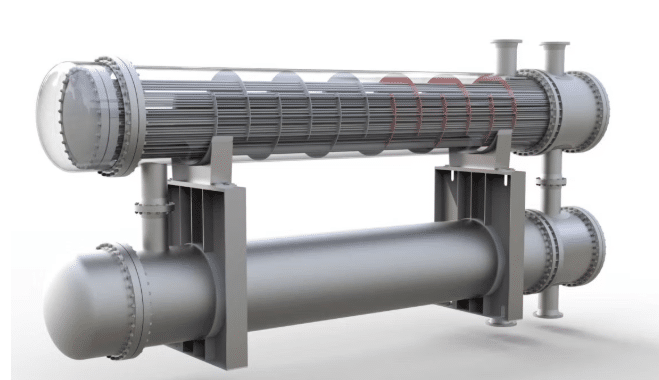
- Shell and Tube: The workhorse of industry. One fluid runs through a series of tubes, while another fluid flows around them inside a large shell. They are incredibly robust and handle high pressures, making them perfect for power plants and large-scale chemical processing.
- Plate Heat Exchanger: Imagine a stack of metal plates with gaps between them. Hot and cold fluids flow through alternating gaps, transferring heat through the thin metal plates. They are compact, highly efficient, and common in HVAC systems, food & beverage production, and even your home’s heating system.
- Finned-Tube: This is your car radiator or the outdoor unit of your air conditioner. Tubes have fins attached to them, dramatically increasing the surface area for better heat transfer to the air.
- Air-Cooled: Used in situations where water is scarce, these use air to cool a fluid directly. You’ll see massive units like these on the roofs of factories or commercial buildings.
Where Do We Use Heat Exchangers?
The applications are vast and touch nearly every aspect of our lives:
- At Home: Your refrigerator uses a heat exchanger to remove heat from inside and release it into your kitchen. Your air conditioner and furnace both rely on them to heat or cool the air in your home.
- Power Generation: In thermal power plants (coal, natural gas, nuclear), heat exchangers (like condensers) are critical for converting steam back into water, a key step in the power cycle.
- Transportation: As mentioned, your car’s radiator is a heat exchanger. So are the intercoolers in turbocharged engines and the heater core that warms the cabin.
- Electronics: The cooling systems in high-performance computers and data centers often use liquid-cooled heat exchangers to manage the intense heat generated by processors.
- Industry: From pasteurizing milk and brewing beer to refining petroleum and manufacturing chemicals, heat exchangers are indispensable for precise temperature control.
Why Should You Care?
Heat exchangers are more than just metal boxes; they are pillars of energy efficiency and sustainability. A well-designed heat exchanger recovers waste heat from one process and uses it to pre-heat another, drastically reducing energy consumption and fuel costs. In a world focused on reducing carbon footprints, heat exchangers are a key technology for a greener future.
Wnioski
The next time you feel a cool breeze from your AC on a hot day or drive your car without it breaking down, take a moment to appreciate the humble heat exchanger. It’s a brilliant piece of engineering that mastered the art of moving energy, making our world safer, more comfortable, and more efficient.
Have you ever encountered a heat exchanger in your daily life or work? Share your stories in the comments below!
For further consultation, please contact our technical team for expert advice.
Whatsapp:86-19106101570
wechat:86-19106101570
email:fob@jsryan.com
 Chinese
  Russian
  Indonesian
  German
  French
  Italian
  Spanish
  Portuguese
  Polish
  Czech
Czech  Turkish
  Korean
  Japanese
  Arabic
  Persian
  Dutch
Dutch  English