
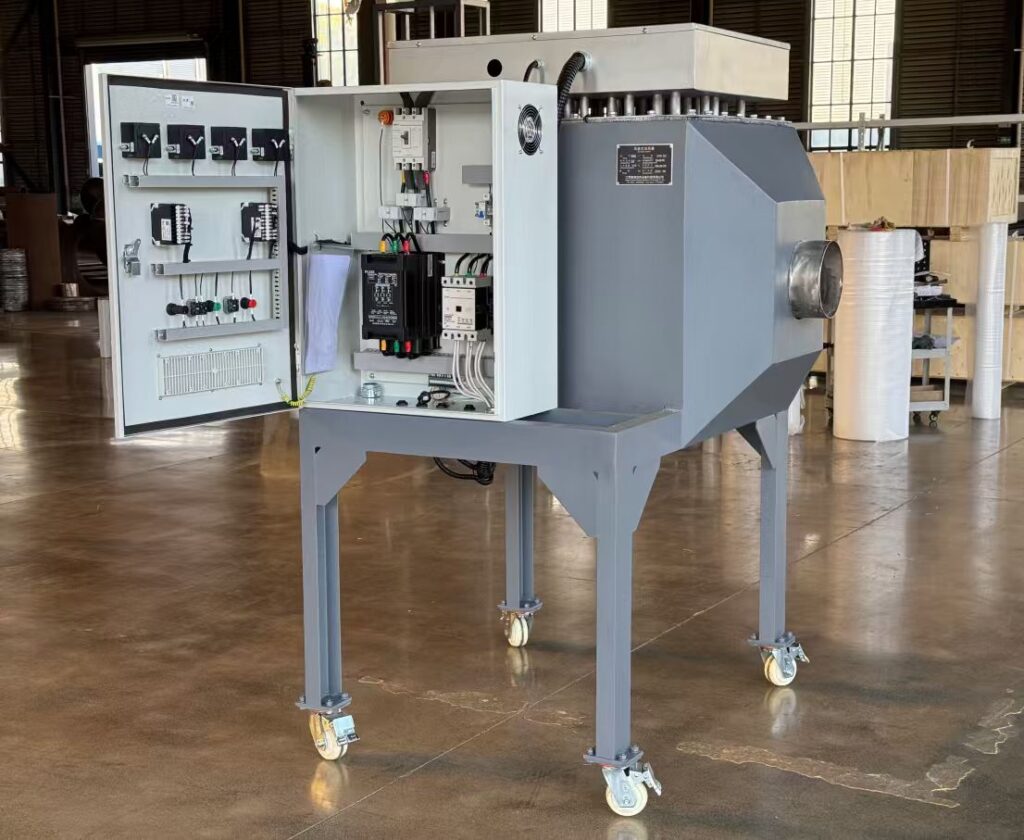
When specifying a duct air heater https://8ruiyan.com/en/all-air-heaters/, one of the first performance questions engineers ask is: How much air resistance will it add to the system? The answer is not a simple yes or no—it depends on element geometry, fin density, and face velocity. However, the air resistance is always measurable and must be treated as a key system parameter, not an afterthought.
1. Where does the resistance come from?
The pressure loss is not caused by “heating” itself—it is purely aerodynamic. The main contributors are:
- Flow obstruction by the heating elements (tubular, finned, or open-coil).
- Turbulence generation around supports, terminal blocks, and mounting flanges.
- Velocity redistribution – the heater forces the air to accelerate through narrow gaps between elements, then decelerate, creating permanent pressure losses.
In short, the heater acts like a compact heat exchanger with a built-in flow restriction.
2. Typical magnitude – a realistic range
For most forced-air applications (velocity 2.5 to 5 m/s, finned tubular elements):
| Configuration | Pressure Drop (Pa) | Pressure Drop (inH₂O) |
|---|---|---|
| Sparse, bare-tube elements | 40 – 100 | 0.16 – 0.40 |
| Standard finned elements | 150 – 350 | 0.60 – 1.40 |
| High-density fins or compact pitch | 400 – 800+ | 1.60 – 3.20+ |
These values are moderate compared to a wet cooling coil (which often exceeds 500 Pa) but significant compared to an empty duct section (near zero).
3. The square-law effect – velocity matters most
The pressure drop scales approximately with the square of air velocity:
ΔP ∝ V²
This means:
- Increasing airflow by 20% raises resistance by ~44%.
- Reducing face velocity from 5 m/s to 3.5 m/s can cut the pressure drop by nearly half.
Therefore, if your fan is already tight on static pressure, reducing velocity (by enlarging the heater cross-section) is the most effective remedy.
4. Operating temperature also plays a role
Hot air is less dense than cold air. At 200°C, air density drops to about 75% of its value at 20°C. Since dynamic pressure is proportional to density, the actual pressure drop at high temperatures is lower than at cold start-up.
Always size the fan for the cold start condition – that is when the resistance peaks.
5. Why this matters for system design
Ignoring heater pressure drop leads to:
- Under-sized fans, resulting in insufficient airflow.
- Overheated elements due to low mass flow (trip on high-limit thermostats).
- Poor temperature uniformity across the duct.
On the other hand, over-estimating it leads to over-sized fans, higher capital cost, and unnecessary energy consumption.
6. Practical recommendations
- Ask for the ΔP curve from the manufacturer – not just a single point.
- Match the heater face area to your duct size. A common rule: keep face velocity ≤ 4 m/s for finned heaters if pressure drop is a concern.
- Consider element orientation – horizontal vs. vertical mounting can affect flow distribution and localized losses.
- Use CFD or manufacturer software for critical applications – empirical hand-calculations often miss entry/exit losses.
Final takeaway
In short, the air resistance of a duct air heater is neither trivial nor unmanageable. It is a predictable consequence of compact heat transfer. With proper velocity selection, accurate fan sizing, and reliable performance data from the manufacturer, this air resistance becomes a routine design input—not a source of uncertainty. Think of it as the cost of doing business in thermal engineering: pay it with good design, and the system will perform as expected.
For further problems about electric air heater, please contact our technical team for expert advice.
Whatsapp:86-19106101570
wechat:86-19106101570
email:fob@jsryan.com
 Chinese
  Russian
  Indonesian
  German
  French
  Italian
  Spanish
  Portuguese
  Polish
  Czech
Czech  Turkish
  Korean
  Japanese
  Arabic
  Persian
  Dutch
Dutch  English