
If you work with polymer processing, you’ve likely heard the question: What temperature should my vacuum cleaning furnace https://8ruiyan.com/en/all-vacuum-cleaning-furnaces/ run at? And more specifically: Is there a real difference between 500°C and 600°C?
The short answer: Yes, the difference is significant. But not always in the way you might expect. Let’s break it down in practical, chemical, and operational terms.
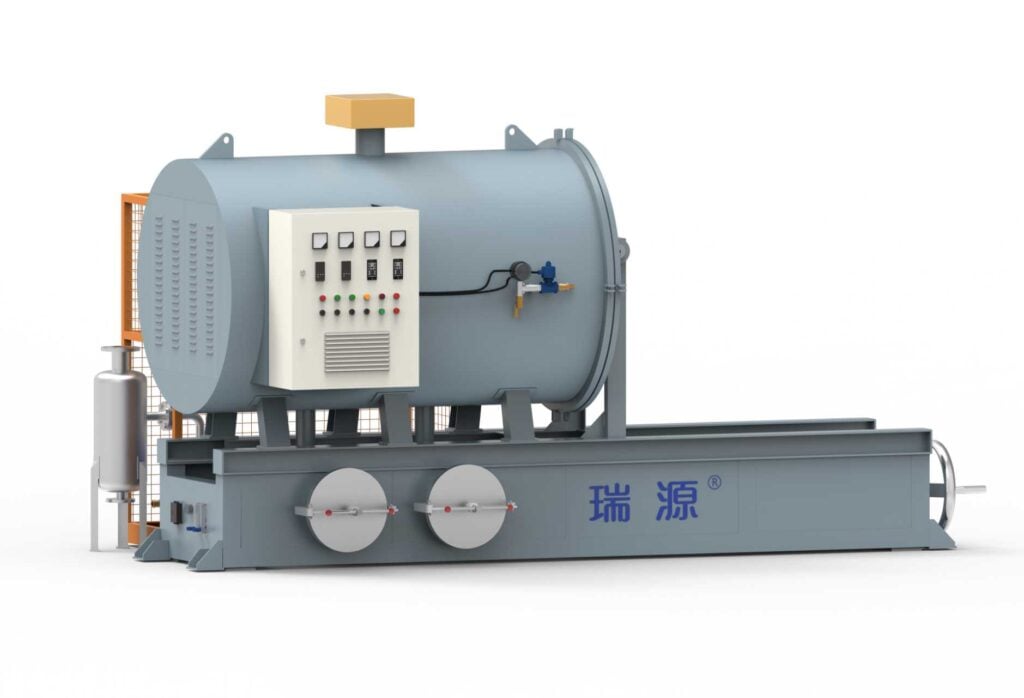
First, What Does a Vacuum Cleaning Furnace Do?
These furnaces (often called vacuum pyrolysis ovens) are used to remove organic residues – like plastics, resins, or adhesives – from metal parts such as spinnerets, filter packs, or extrusion dies.
The process works by heating the parts in a low‑oxygen environment. Instead of burning the residue (which can damage the metal), the heat causes the polymer to decompose into volatile gases and a small amount of solid carbon residue (char). The gases are then pulled out by a vacuum system and typically combusted in an afterburner.
So, Why 500°C vs. 600°C?
At 500°C:
- Most common polymers (PE, PP, PET, nylon, acrylics) will fully decompose.
- The char left behind is usually soft and powdery, easily removed by a light air blow or water rinse.
- Metal parts experience minimal thermal stress. Dimensional stability and surface hardness are well preserved.
- Energy consumption is moderate, and furnace component life (heaters, insulation, seals) tends to be longer.
At 600°C:
- Decomposition is faster – often 30–50% shorter cycle times.
- More stubborn residues (like cross‑linked polymers, thermosets, or high‑temperature engineering plastics) finally break down completely.
- However, the char can become harder and more graphitic, sometimes requiring mechanical brushing or light grit blasting.
- The extra heat accelerates oxidation of the metal surface (even in vacuum, trace oxygen exists), which may slightly change the surface finish or reduce the life of precision parts over many cycles.
- Energy use rises noticeably, and furnace maintenance intervals typically shorten due to higher thermal load on internal components.
The Key Is Not “Which Is Better” – It’s “Which Fits Your Residue”
If your typical residue is standard thermoplastic or general‑purpose adhesive, 500°C is usually the sweet spot. It cleans thoroughly, protects your tooling, and keeps operating costs lower.
Only step up to 600°C if:
- You regularly process high‑temperature engineering resins (e.g., PEEK, PTFE, PI, or liquid crystal polymers).
- You have thick, heavy build‑ups that need faster throughput.
- Your current 500°C cycles leave a sticky or unburned carbon layer that requires manual scraping.
A Practical Rule of Thumb
Start at 500°C. Run a test cycle with your dirtiest parts. If the char brushes off easily and the surface looks clean, you’re done – stick with it.
If the residue remains hard or tacky, raise the temperature in 25°C steps up to 600°C until you find the minimum temperature that gives a clean result in an acceptable time.
Remember: The goal is not the highest temperature, but the lowest temperature that does the job reliably. Every extra 100°C costs energy, maintenance, and eventually, part life.
Final Takeaway
| Temperature | Speed | Residue Type | Metal Impact | Energy & Maintenance |
|---|---|---|---|---|
| 500°C | Good | Common thermoplastics | Low | Moderate |
| 600°C | Fast | High‑temp / cross‑linked polymers | Moderate | Higher |
So yes – 500°C and 600°C are very different in practice. But the smarter question is: What does your residue actually need? Answer that, and the temperature choice becomes clear.
Have questions about your specific polymer or part geometry? Drop a comment – we’re happy to help you find your real-world optimum.
For further problems about Vakuové čištění pece , please contact our technical team for expert advice.
Whatsapp:86-19106101570
wechat:86-19106101570
email:fob@jsryan.com
 Chinese
  Russian
  Indonesian
  German
  French
  Italian
  Spanish
  Portuguese
  Polish
  Czech
Czech  Turkish
  Korean
  Japanese
  Arabic
  Persian
  Dutch
Dutch  English