
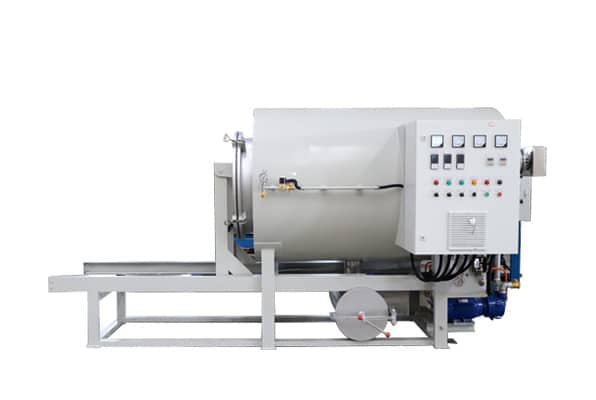
For a vacuum cleaning furnacehttps://8ruiyan.com/en/all-vacuum-cleaning-furnaces/, full vacuumisn’t just a number on a display—it is the critical condition that ensures thermal decomposition of residues happens efficiently and evenly. When the system fails to pull down to that target level, the cleaning process suffers, and you are left with subpar results. The challenge is that the culprit is rarely obvious. It could be a tiny leak past a worn seal, an oil-starved pump, an overload of water vapor, or even a dirty gauge giving false hope. In this guide, we will strip away the mystery and show you exactly where to look first.
This problem usually stems from one of four categories: leaks, pump issues, process contamination, or instrument errors.
1. Air Leaks (The Most Common Culprit)
Think of your furnace as a balloon. If there is even a pinhole, air rushes in and destroys the vacuum. In a furnace, common leak points include:
- Door seals (O-rings): These harden or crack over time due to high heat. A tiny piece of carbonized residue on the sealing surface can also create a gap.
- Flanges and feed-throughs: The connections for thermocouples, power lines, or gas inlets are frequent weak spots.
- Valve stem seals: Internal valves that isolate the vacuum pump can wear out.
The fix? Perform a simple “pressure rise test.” Close the main valve to isolate the pump, then watch the pressure gauge. If the pressure rises faster than 1-2 Torr per minute, you definitely have a leak. Use a helium leak detector or spray a little alcohol around suspicious joints while watching the gauge—a sudden spike reveals the leak location.
2. Pump System Performance Problems
Your pumping system does the heavy lifting. If it is underperforming, the furnace will never reach the target vacuum.
- Low oil level or degraded oil: Rotary vane pumps rely on oil for both lubrication and sealing. If the oil is cloudy, low, or smells burnt, it cannot maintain the compression ratio needed for high vacuum.
- Failed valves in the pump: Many pumps have anti-suckback or gas-ballast valves. If these stick open, they allow atmospheric air to bleed back into the system.
- Dirty pump filters or exhaust traps: Clogged exhaust filters create back-pressure, reducing the pump’s effective speed.
- Wrong pump type: Remember that a single-stage rotary vane pump might only reach 1 Torr, while your cleaning process may require 0.1 Torr. If you have recently changed the process, you may have outgrown your pump.
3.Process-Intrinsic Issues (Water Vapor and Condensables)
Here is a counter-intuitive fact: The biggest “gas” in your furnace might not be air—it could be water vapor or evaporated volatiles from the parts being cleaned.
- Moisture in the load: If your filters or tooling are wet from a prior wash, that water turns into vapor under heat. Vapor takes up a lot of volume and is difficult for an oil-sealed pump to remove without a cold trap.
- High process temperature: As the furnace heats up, absorbed gases desorb from the chamber walls and the workload itself. This is called “outgassing.” It is normal to see the vacuum dip when you apply heat. If your vacuum level does not recover after holding the temperature for 15–20 minutes, your pump may be undersized for the amount of residue you are processing.
4. Vacuum Gauge Misreading (Trust, but Verify)
Sometimes the system is fine—the gauge is lying.
- Thermal conductivity gauges (like Pirani) are sensitive to gas composition. If you are introducing nitrogen or argon for a purge, the gauge reading will shift compared to air.
- Ionization gauges can become contaminated with process residues, giving false high or low readings.
- Always cross-check your main gauge against a mechanical Bourdon tube or a secondary capacitance manometer. If they disagree, you have an instrumentation problem, not a vacuum problem.
5. Blockages in the Gas Path
A vacuum system is a pipeline. If that pipeline is partially clogged, the pump will struggle to pull the gas out.
- Check the valve between the chamber and the pump. Ensure it opens fully.
- Inspect the cold trap or dust filter at the furnace outlet. Over time, pyrolyzed carbon and ash can accumulate, restricting flow. A simple cleaning of these components can restore full vacuum instantly.
A Quick Decision Flowchart for Your Shift
- Is the pump sound normal? (A sharp, sputtering sound indicates low oil; a quiet, smooth sound is healthy.)
- Is the leak rate acceptable? (Run the pressure-rise test with the pump off.)
- Is the load dry? (If questionable, run a dry, empty cycle to compare performance.)
- Is the gauge calibrated? (Zero the gauge at atmosphere and check it at a known reference.)
Final Thought
Do not assume the pump is broken every time full vacuum seems out of reach. In our experience, over 70% of “vacuum failure” calls end up being something far simpler—a worn door seal, a dirty inlet trap, or even a wet load. Start your troubleshooting with the easy stuff: check the seals, clean the filters, and run an empty cycle for comparison. More often than not, you will restore full vacuum without ever touching the pump. And when you do, your cycle times will drop, your parts will come out cleaner, and your frustration will melt away.
Have a specific symptom you’d like to ask about? Drop a comment below, and we can dig deeper into your particular system setup!
For further problems about Full Vacuum , please contact our technical team for expert advice.
Whatsapp:86-19106101570
wechat:86-19106101570
email:fob@jsryan.com
 Chinese
  Russian
  Indonesian
  German
  French
  Italian
  Spanish
  Portuguese
  Polish
  Czech
Czech  Turkish
  Korean
  Japanese
  Arabic
  Persian
  Dutch
Dutch  English
I visited several blogs except the audio quality for audio songs present at this
website is genuinely wonderful.
Thank you. Please feel free to contact us if you need any assistance. WHATSAPP +86 19106101570