
Modern electric thermal oil heaters https://8ruiyan.com/en/all-organic-heat-carrier-boilers/ need precise temperature control. Two common technologies are solid state contactors (SSC) and silicon controlled rectifiers (SCR). Both are reliable. But they work differently. Choosing the right one affects performance, cost, and equipment life.
Let’s look at how they work, their differences, and how to choose.
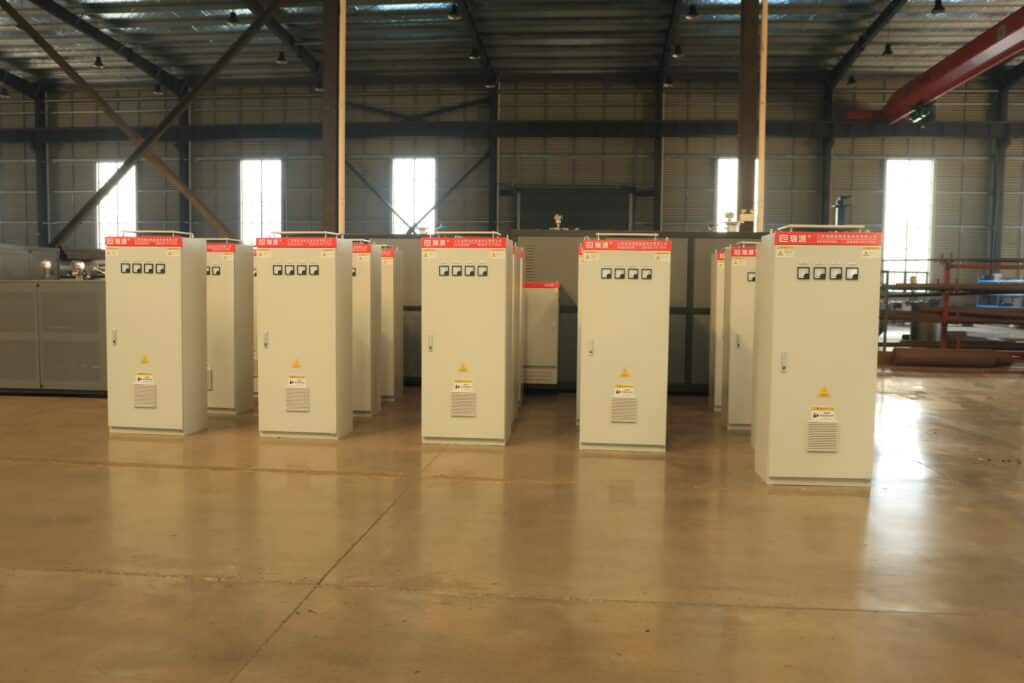
What Is a Solid State Contactor (SSC)?
A solid state contactor is an electronic switch. It turns the heater on or off. It does this very fast – many times per second. But it is still a simple “on/off” device.
How it works: The controller compares the actual temperature to the setpoint. When heating is needed, the SSC turns on full power. When the temperature is close to setpoint, it turns off. This cycle repeats very quickly.
Pros of SSC:
- Lower initial cost
- Simpler design
- No harmonic distortion on the power line
- Good for applications that do not need extreme precision
Cons of SSC:
- Temperature fluctuates slightly (on/off cycles)
- Not ideal for processes that need ultra‑smooth heating
What Is an SCR (Silicon Controlled Rectifier)?
An SCR is also called a thyristor power controller. It does not just turn power on or off. It adjusts the power smoothly. This is called “phase angle control” or “burst firing.”
How it works: The SCR sends only part of each voltage cycle to the heater. For example, it might send 60% of the cycle, then 40%, then 50%. The heater receives a continuous, adjustable amount of power.
Pros of SCR:
- Very precise temperature control
- No temperature spikes or fluctuations
- Smooth heating – ideal for sensitive processes
- Extends heater life by reducing thermal shock
Cons of SCR:
- Higher initial cost
- Slightly more complex setup
- Can create electrical harmonics (special filters may be needed)
Key Differences at a Glance
| Feature | Solid State Contactor (SSC) | SCR (Thyristor) |
|---|---|---|
| Control type | On/off (fast cycling) | Proportional (smooth power adjustment) |
| Temperature precision | Good | Excellent |
| Temperature fluctuation | Slight | Almost none |
| Heater stress | Moderate | Low |
| Electrical noise | Low | Some harmonics possible |
| Cost | Lower | Higher |
| Best for | General industrial heating | High‑precision processes |
How to Choose Between SSC and SCR
Choose a solid state contactor if:
- Your process does not require extreme accuracy (±1–2°C is acceptable)
- You want to keep initial investment lower
- The heating system is relatively simple (e.g., tank heating, air heating)
- Your power supply is less sensitive to electrical noise
Choose an SCR if:
- Your process needs tight temperature control (±0.5°C or better)
- The product is sensitive to temperature changes (e.g., chemical reaction, plastic extrusion)
- You want to extend heater life by reducing thermal shock
- You are willing to invest more upfront for better performance and efficiency
Special Note on Thyristor Soft Start
Even if you choose SSC for normal control, you may still want an SCR‑based “soft start” for large heaters. Soft start gradually increases power when the heater first turns on. This avoids a sudden current surge. It protects the electrical system and extends heater life.
Conclusione
Both solid state contactors and SCRs work well for electric thermal oil heaters. The choice depends on your temperature accuracy needs, budget, and process sensitivity.
- Use SSC for general, cost‑sensitive applications.
- Use SCR for high‑precision, high‑quality processes.
If you are unsure, ask your heater supplier. Share your process details. They can recommend the best control for your specific application.
For further problems about precise temperature control , please contact our technical team for expert advice.
Whatsapp:86-19106101570
wechat:86-19106101570
email:fob@jsryan.com
 Chinese
  Russian
  Indonesian
  German
  French
  Italian
  Spanish
  Portuguese
  Polish
  Czech
Czech  Turkish
  Korean
  Japanese
  Arabic
  Persian
  Dutch
Dutch  English