
If you work in manufacturing, you may hear these two terms. A quenching furnace and a mold temperature controller https://8ruiyan.com/en/all-organic-heat-carrier-boilers/. They sound similar. But they do very different jobs.
What Is a Quenching Furnace?
A quenching furnace is a heat treatment machine. It is used mainly for metal. The furnace heats metal parts to a very high temperature. Then the metal is cooled down quickly. This rapid cooling is called quenching.
Why do we do this? To make metal harder and stronger. It also makes the metal more wear-resistant. This is important for parts that face heavy stress.
Think about gears, bearings, cutting tools, and car engine parts. They all need to be tough. A quenching furnace helps make them that way.
The process usually has three steps. First, heating. Second, soaking at a high temperature. Third, quenching in water, oil, or air. Sometimes there is also a tempering step after quenching. That reduces brittleness.
A quenching furnace can reach extreme temperatures. Often between 800°C and 1200°C. Some special furnaces go even higher. It is a large, heavy piece of equipment. It usually stays in one spot on the factory floor. It needs strong power and good ventilation.
What Is a Mold Temperature Controller?
A mold temperature controller is a very different machine. It is used in plastic injection molding and rubber molding. Its job is to keep a mold at the right temperature.
A mold is a metal tool with a hollow shape inside. Hot plastic is injected into that shape. Then the plastic cools and hardens. The mold opens, and the finished part drops out.
But here is the problem. If the mold is too cold, the plastic cools too fast. That can cause defects. If the mold is too hot, the plastic cools too slowly. That wastes time and energy.
So the mold temperature controller solves this. It pumps water or oil through channels inside the mold. The controller heats or cools that fluid. This keeps the mold at a steady, ideal temperature.
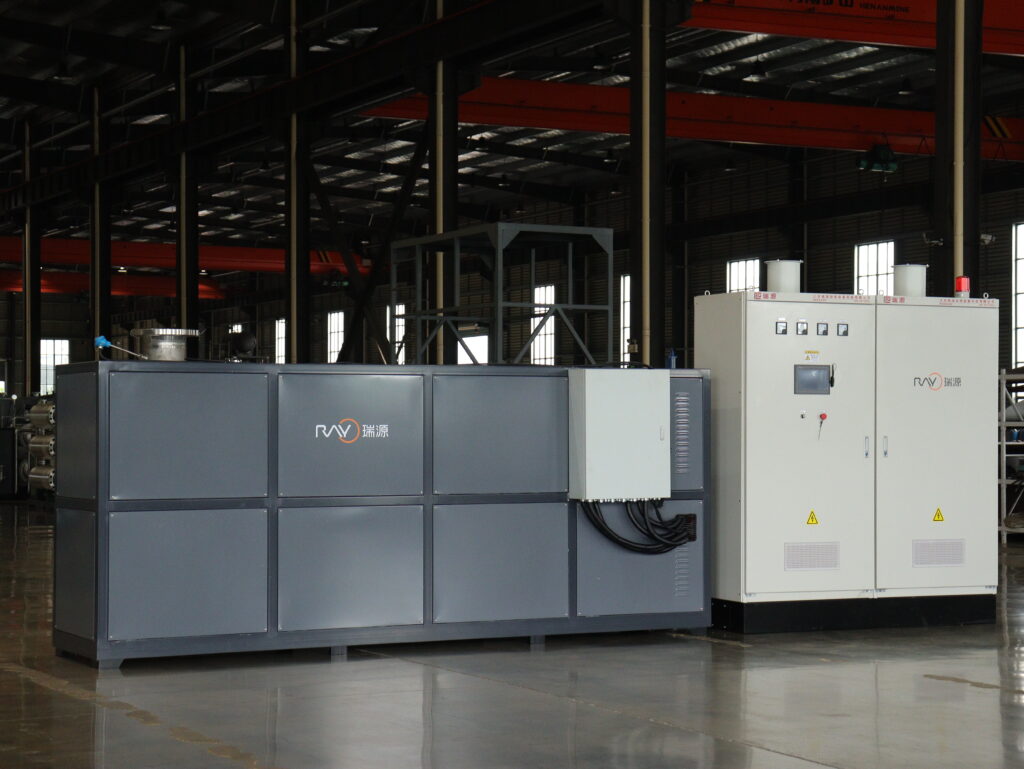
The working temperature is much lower than a quenching furnace. Usually between 20°C and 300°C. Some high-end models go a bit higher. The machine itself is smaller. It looks like a cabinet or a small box. It often sits right next to the molding machine.
Key Differences at a Glance
Here is a simple comparison. You can scan it quickly.
- Main Purpose: Quenching furnace hardens metal. Mold temperature controller stabilizes mold heat.
- Industry: Quenching serves metallurgy, tools, and auto parts. Mold control serves plastics and rubber.
- Temperature Range: Quenching is very hot (800–1200°C+). Mold control is mild (20–300°C).
- Material Being Treated: Quenching works on metal. Mold control works on plastic or rubber.
- Size and Shape: Quenching furnace is large and heavy. Mold controller is compact, like a cabinet.
- Process Type: Quenching is a batch heat treatment. Mold control is a continuous cycle.
- Cooling Method: Quenching uses water, oil, or air. Mold control uses water or oil in a closed loop.
- Operator Attention: Quenching needs careful timing. Mold control runs mostly automatically.
Why People Confuse Them
Both machines involve heat. Both are used in factories. Both have temperature controls. That is where the similarity ends.
But the confusion is real. A new worker might hear “furnace” and think of a mold controller. Or someone might think a mold controller can harden metal. It cannot.
The biggest difference is the goal. One machine changes the internal structure of metal. The other machine just keeps a mold warm or cool. One is about strength. The other is about shape and surface quality.
A Simple Analogy
Think of a quenching furnace like a blacksmith’s forge. It makes metal strong by heating and cooling.
Think of a mold temperature controller like a thermostat in your home. It keeps the temperature steady. It does not change the material itself.
That is a simple way to remember.
Summary
A quenching furnace makes metal hard and strong. A mold temperature controller keeps plastic molding stable and efficient. They work at different temperatures. They serve different materials. They belong to different parts of manufacturing.
If you remember two things, you will never confuse them. First, the material: metal vs. plastic. Second, the temperature: very hot vs. warm. That is the core difference.
For further problems about mold temperature controller, please contact our technical team for expert advice.
Whatsapp:86-19106101570
wechat:86-19106101570
email:fob@jsryan.com
 Chinese
  Russian
  Indonesian
  German
  French
  Italian
  Spanish
  Portuguese
  Polish
  Czech
Czech  Turkish
  Korean
  Japanese
  Arabic
  Persian
  Dutch
Dutch  English