
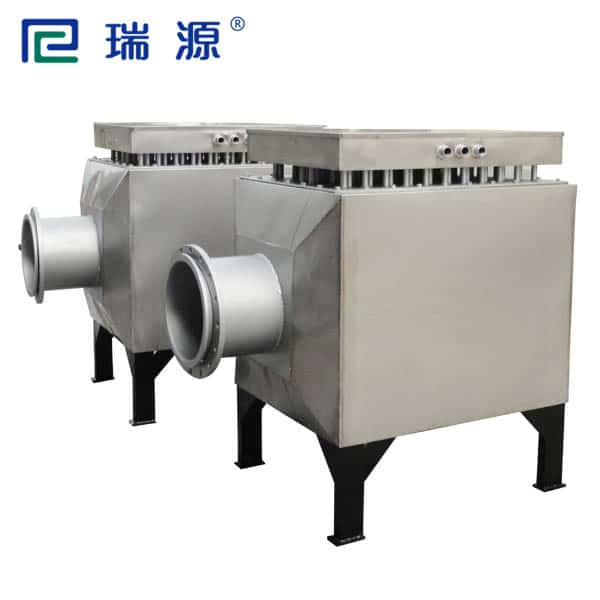
When sizing a hot air system for a drying process, the first question is often: should we use an electric air heater https://8ruiyan.com/en/all-air-heaters/, or go with steam / gas?
The short answer: electric is rarely the cheapest to run, but often the smartest overall choice—depending on your scale, duty cycle, and site constraints.
Let’s break it down simply.
1. Operating Cost (The Obvious Part)
Electric resistance heating is nearly 100% efficient at the point of use. All input electricity becomes heat.
However, electricity is 2–4× more expensive per kWh than natural gas or waste steam (on an energy-content basis).
Rough rule of thumb:
For continuous, high-power drying (>50 kW thermal), electric operating cost typically exceeds gas by 2.5–3×.
So if you run 24/7 at full load, electric is not cost-effective—go with gas or steam.
2. Where Electric Wins (The Hidden Savings)
Electric heaters become highly cost-effective when:
- Duty cycle is low (<30% run time) – no standby losses, instant on/off.
- Process temperature is moderate (80–200°C) – no boiler efficiency loss.
- No water treatment, no flue gas, no condensate return – zero auxiliary equipment.
- Space is tight – compact, wall-mountable, no burner room required.
In these cases, the lower capital cost + negligible maintenance often offsets higher electricity bills within 1–2 years.
3. Capital & Installation Comparison
| Item | Electric | Gas / Steam |
|---|---|---|
| Heater cost | Low | 2–4× higher |
| Piping / ductwork | Simple | Complex (fuel lines, vents) |
| Permits & inspections | Minimal | Significant |
| Installation time | Days | Weeks |
| Auxiliary power | Only fan + heater | Fan + burner + pumps + controls |
For small to medium dryers (e.g., 5–30 kW thermal), electric total installed cost is often 50–70% lower.
4. Control Precision & Response
Electric heaters respond within seconds. Temperature stability ±1°C is routine.
Gas burners have longer ramp-up, turndown limits, and flame instability at low load.
If your product is heat-sensitive or batch quality varies with temperature, electric gives you process reliability that directly reduces scrap—a cost saving rarely included in energy comparisons.
5. The Practical Payback Test
A simple decision flow:
- Run hours > 4,000/year → gas/steam usually cheaper over 3 years.
- Run hours < 2,000/year → electric almost always cheaper overall.
- Between 2,000–4,000 → compare local electricity vs. fuel prices + installation quotes.
Also check: does your site already have a boiler? If yes, steam is hard to beat. If no, adding a boiler just for a small dryer is rarely economical.
6. A Real-World Example
- 20 kW thermal demand
- 2,000 hrs/year operation
- Electricity: $0.12/kWh → annual energy = $0.12 × 20 × 2,000 = $4,800
- Gas (80% efficiency, $0.04/kWh equivalent) → ~$2,400/year
Electric costs $2,400 more per year in energy.
But electric installation saves ~$5,000 upfront.
Break-even: ~2 years. After that, gas is cheaper—but only if you run consistently.
Conclusion – The Bottom Line
Electric is not “cheaper to run” —it costs more per unit of heat.
But cost-effective means total cost over your actual use pattern. For intermittent, small-to-medium, or precision drying, electric is often the most economical choice when you include capex, installation, maintenance, and downtime.
For heavy continuous production? Skip electric. Go gas or steam.
For everything else—run the numbers with your real duty cycle. You might be surprised.
Final practical tip: If you choose electric, always oversize the heater by 15–20% and use SCR power control—not on/off contactors. That saves energy and extends element life significantly.
For further problems about electric air heater, , please contact our technical team for expert advice.
Whatsapp:86-19106101570
wechat:86-19106101570
email:fob@jsryan.com
 Chinese
  Russian
  Indonesian
  German
  French
  Italian
  Spanish
  Portuguese
  Polish
  Czech
Czech  Turkish
  Korean
  Japanese
  Arabic
  Persian
  Dutch
Dutch  English