
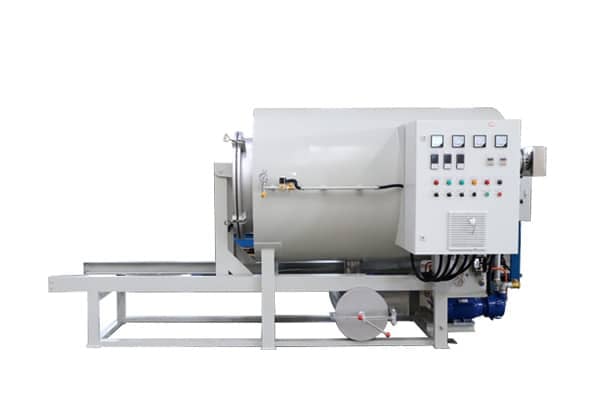
Vacuum calcination (vacuum pyrolysis) https://8ruiyan.com/en/all-vacuum-cleaning-furnaces/is commonly used to clean polymer processing equipment fouled by polymer residue. Examples include spinnerets and extrusion dies. This method removes the residue without oxidizing metal parts. The key difference from air-fired burnout is the absence of oxygen. The polymer does not burn and does not form CO₂ and water. Instead, it undergoes thermal cracking and breaks down into smaller fragments. These fragments are removed as vapors or left behind as carbonaceous residue. The exact products depend on the polymer type and the calcination temperature.
The General Picture
Under vacuum or inert atmosphere, polymers do not “burn” in the conventional sense. They thermally decompose into three types of products:
- Volatile fragments: These include monomers, oligomers, and light hydrocarbons. If the polymer contains oxygen or nitrogen, inorganic gases such as CO, CO₂, or H₂O may also be present. These substances are pumped away.
- Condensable oils and waxes: These may deposit in cooler zones of the furnace or vacuum line.
- Solid carbonaceous residue (char): This remains on the equipment surface. It is later removed by brushing or a secondary oxidative step.
For equipment such as spinnerets and dies, the goal is to leave a friable char. Such char releases easily from metal. It does not form a fused or cross-linked crust. Therefore, vacuum calcination is often preferred over air burnout for parts with intricate channels or oxidation-sensitive metallurgy.
Polystyrene (PS)
Polystyrene is one of the most thoroughly studied polymers under vacuum pyrolysis. This is mainly because its depolymerization is clean and follows an “unzipping” mechanism. Under vacuum at moderate temperatures (roughly 400–450 °C), PS depolymerizes predominantly to styrene monomer. Reported styrene yields range from 55–85%, depending on process conditions and feed type (general-purpose or expanded PS). Besides styrene, smaller amounts of toluene, benzene, ethylbenzene, and styrene dimers and trimers are also produced.
For a spinneret or die contaminated with PS, this situation is relatively favorable. Most of the polymer leaves as volatile styrene. Polystyrene leaves almost no ash after volatiles evolve, so the residue tends to be low in carbon. The main caution is that styrene vapor can condense in cooler exhaust lines. Traps are therefore advisable.
Polypropylene (PP)
Polypropylene does not unzip as cleanly as PS. Vacuum pyrolysis of PP at 400–500 °C produces a broad distribution of hydrocarbons. The condensable fraction is often described as waxes and oils. These consist of alkanes and alkenes spanning roughly C₆ to above C₂₅. The heavier fraction (above C₂₀) is responsible for wax formation. Under vacuum, primary products leave the hot zone quickly. This limits secondary cracking and tends to favor condensable products over permanent gases.
In a calcination context, PP residue is more likely to leave a waxy condensate in the vacuum line. It also tends to leave somewhat more char on the part compared with PS. The char is generally still removable, but wax management is the practical nuisance.
Polyethylene (PE)
High-density polyethylene behaves similarly to PP under vacuum, but its product slate is more paraffinic. Vacuum pyrolysis of HDPE yields wax and an oily liquid. Their composition is dominated by saturated and unsaturated hydrocarbons. Reported chain lengths fall in the C₇–C₂₉ range. At lower-temperature vacuum outgassing (closer to baking than calcination), HDPE releases mainly H₂O and CₙHₓ species with n up to about 9.
For equipment cleaning, PE and PP are often grouped together in practice. Both leave waxy condensates and a carbon residue. Both require temperatures high enough to crack the wax into lighter fragments or to leave a dry char.
Polymers with Heteroatoms (Nylons, Polyesters, Polycarbonates)
Polymers containing oxygen or nitrogen in the backbone behave differently. Nylons, polyesters, and polycarbonates do leave a carbonaceous ash after volatile evolution. This differs from polyolefins and polystyrene. More importantly, their vacuum decomposition releases CO, CO₂, and H₂O as primary volatile products. It also releases hydrocarbon fragments and, in the case of nylons, nitrogen-containing species.
This matters for equipment cleaning. The carbon residue from these polymers can be harder and more adherent than the soft char from PS or PE. Workshop experience suggests that nylon and polyester residues on spinnerets often require a longer calcination hold. A higher final temperature may also be needed to render the char friable.
Practical Implications for Spinnerets and Dies
The choice of calcination conditions should match the polymer contaminant. For polystyrene, a moderate vacuum bake may be sufficient. It can remove most of the material as styrene vapor and leave minimal residue. For polyolefins, expect wax condensation in the exhaust. Plan for a final char removal step. For engineering polymers with heteroatoms, allow for a more tenacious carbon residue. Also verify that the furnace’s vacuum capability can handle CO and CO₂ evolution without compromising the pump.
One final note: “vacuum calcination” in equipment maintenance is often run at temperatures well below the 800–900 °F (roughly 430–480 °C) cited in older patent literature. Lower temperatures reduce the risk of metallurgical damage. However, they may leave a partially degraded, tacky polymer residue rather than a clean char. The optimal temperature is therefore a compromise between polymer residue removal and part safety. It is best determined empirically for each polymer-metal combination.
Conclusion
For further problems about Polymer Residue, please contact our technical team for expert advice.
Whatsapp:86-19106101570
wechat:86-19106101570
email:fob@jsryan.com
 Chinese
 Russian
 Indonesian
 German
 French
 Italian
 Spanish
 Portuguese
 Polish
 Czech
 Turkish
 Korean
 Japanese
 Arabic
 Persian
 Dutch
 English